The U.S. Department of Justice sued S&K Towing Inc., a San Clemente, California towing company, on March 25, 2026, alleging it illegally sold or disposed of 148 vehicles belonging to active-duty military servicemembers in violation of the Servicemembers Civil Relief Act. Many of those vehicles were towed directly from Marine Corps Base Camp Pendleton — by a company that held a contract with the base requiring it to follow federal law.
The case was filed in the U.S. District Court for the Central District of California in Santa Ana. It is being handled by the Civil Rights Division’s Housing and Civil Enforcement Section and the U.S. Attorney’s Office for the Central District of California under First Assistant U.S. Attorney Bilal A. Essayli. The lawsuit is ongoing as of June 2026. No settlement has been announced.
- What: S&K Towing allegedly sold or disposed of 148 military vehicles without the court orders required by federal law.
- Who: United States of America vs. S&K Towing Inc., San Clemente, California.
- Status: Ongoing — federal lawsuit filed March 25, 2026, in the Central District of California.
- Law violated: Servicemembers Civil Relief Act (SCRA), which requires a court order before selling a servicemember’s vehicle.
- Settlement: Pending — no settlement reached as of June 2026.
- Eligibility: Servicemembers whose vehicles were towed and sold by S&K Towing without a court order may be eligible for monetary damages.
- Key date: May 2024 — military lawyer warned S&K of the violations; company continued anyway.
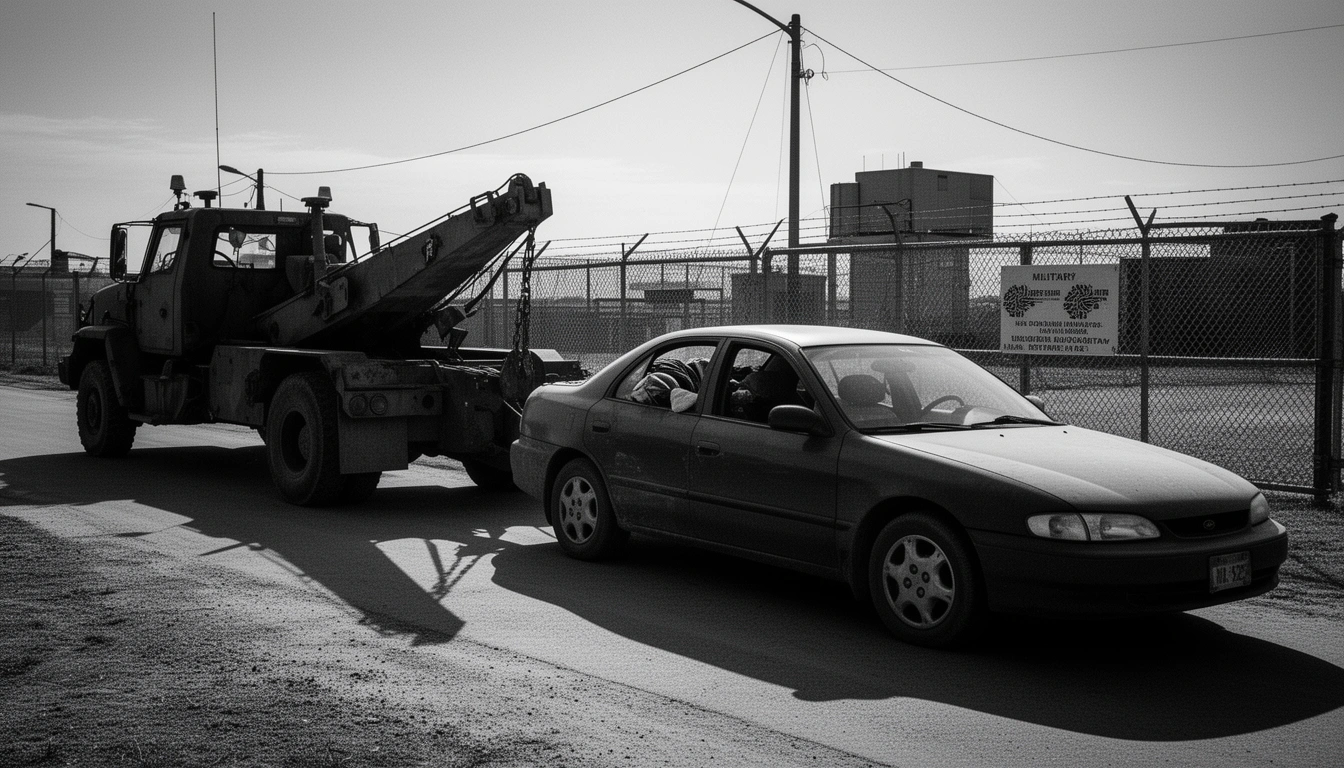
S&K Towing Lawsuit Timeline and Updates
August 2020 — S&K Towing Begins Operating at Camp Pendleton
S&K Towing Inc. began providing towing services at Marine Corps Base Camp Pendleton in August 2020 under a memorandum of agreement with the base. The contract gave S&K the authority to respond to calls from Camp Pendleton’s base police department and remove vehicles from the installation.
The agreement came with a legal obligation. Under its terms, S&K was required to comply with all applicable federal and state laws. One of those laws was the Servicemembers Civil Relief Act, which mandates that towing companies obtain a court order before selling or disposing of any vehicle owned by an SCRA-protected servicemember.
According to the DOJ’s complaint, S&K made no effort to comply with the SCRA from the day it started working at Camp Pendleton.
August 2020 to April 2025 — 148 Vehicles Sold or Disposed Of
Over nearly five years, S&K Towing towed hundreds of vehicles from Marine Corps Base Camp Pendleton, stored them at its facility, and then sold or disposed of them to recover unpaid towing and storage fees. Under California law, towing companies may enforce a garageman’s lien by conducting a public sale or transferring the vehicle to a licensed dismantler or scrap processor.
Federal law limits that right when the vehicle owner is on active military duty. The SCRA requires tow companies to go to court first. The judge then decides whether the sale may proceed and can adjust fees to account for the servicemember’s military obligations.
S&K skipped that step. Every time. According to the complaint, the company sold or disposed of as many as 148 vehicles owned by protected servicemembers without obtaining a single court order. Some of those vehicles still had military equipment inside. Some still had uniforms. Some still had military awards and medals.
May 2024 — A Military Lawyer Warned Them Directly
In May 2024, a Military Legal Assistance attorney at Camp Pendleton contacted S&K Towing by letter and by phone. The attorney explained, clearly and directly, that the company was violating the SCRA.
A manager at S&K Towing responded: “We do this all the time.”
That response is now in the federal complaint. After that exchange, S&K Towing continued to sell and dispose of vehicles owned by SCRA-protected servicemembers without court orders. The violations did not stop. The DOJ alleges the company had no policies, procedures, or training related to SCRA compliance — and never used the Department of Defense database that exists specifically to help businesses verify whether a vehicle owner is on active duty.
March 25, 2026 — DOJ Files Suit
The Justice Department filed its complaint against S&K Towing Inc. in federal court in Santa Ana on March 25, 2026. The Civil Rights Division’s Housing and Civil Enforcement Section brought the case alongside the U.S. Attorney’s Office for the Central District of California.
Assistant Attorney General Harmeet K. Dhillon of the Civil Rights Division announced the action. “Towing companies must respect and abide by the federal laws that protect members of our Armed Forces,” Dhillon said. “Servicemembers are often absent for extended periods due to training and deployments and may not know that their vehicle has been towed. The SCRA plays an important role in providing these servicemembers with adequate legal protections.”
First Assistant U.S. Attorney Bilal Essayli added: “It is unacceptable for a business to sell or dispose of servicemembers’ vehicles without abiding by the laws that protect servicemembers.” A man who answered the phone at S&K Towing after the suit was filed said the company had no comment.
What the Lawsuit Alleges
The DOJ’s complaint makes three core claims. First, S&K violated the SCRA systematically — not accidentally. The company towed vehicles bearing Camp Pendleton addresses, including vehicles registered to barracks rooms inside the base. Second, S&K continued the violations even after receiving a direct warning from military legal counsel. Third, S&K had no compliance infrastructure: no written policies, no employee training, and no use of the DOD’s SCRA verification database.
The pattern the complaint describes is not one of oversight. It is one of indifference. Vehicles registered to base addresses were sold. Vehicles whose owners were identified as active military were sold. Vehicles containing uniforms, military gear, and service awards were sold. None of it triggered a pause. None of it prompted a court filing.
The government is seeking three forms of relief: monetary damages for each affected servicemember; civil penalties payable to the United States; and a court order requiring S&K to adopt SCRA-compliant policies and procedures to prevent future violations.
What the SCRA Actually Requires — and Why S&K Ignored It
The Servicemembers Civil Relief Act was enacted in 2003 as a successor to the Soldiers’ and Sailors’ Civil Relief Act of 1940. Congress designed it to address a specific problem: active-duty military personnel are frequently unavailable to manage their civilian affairs. A Marine deployed to a combat theater cannot easily appear in a California impound lot to pay towing fees.
The SCRA’s vehicle protection provision is straightforward. When a towing or storage company wants to sell or dispose of a servicemember’s vehicle to recover unpaid fees, it must first file for a court order. The court can then notify the servicemember through proper channels, consider whether military duties prevented timely payment, and adjust fees accordingly. The sale cannot proceed without judicial approval.
This process takes time and costs the towing company filing fees. The shortcut — selling without a court order — is faster and cheaper. According to the DOJ’s complaint, S&K chose the shortcut every single time for nearly five years.
The company also failed to use the DoD’s Defense Manpower Data Center (DMDC) database, a free federal tool available to any business that allows them to check a vehicle owner’s military status before proceeding with a sale. Using it takes minutes. S&K did not use it.
The “We Do This All the Time” Problem
Four words in the federal complaint stand apart from everything else: “We do this all the time.”
That statement, attributed to an S&K manager responding to a military attorney’s warning in May 2024, is more damaging to S&K’s legal position than almost any other fact in the case. It eliminates the most common defense in SCRA litigation: mistake or ignorance. S&K cannot argue it didn’t know about the SCRA after a military lawyer explained it in writing and by phone. It cannot argue the violations were accidental after a manager acknowledged the practice openly.
In past SCRA towing cases, ignorance of the law and the absence of compliance infrastructure has been treated as a factor that reduces culpability. S&K Towing’s own words eliminate that argument. What remains is a company that knew the law, knew it was violating the law, was told it was violating the law, and kept violating the law.
That pattern has direct implications for civil penalties. Under the SCRA, courts have discretion to award civil penalties in addition to compensatory damages. The DOJ is asking for both.
How DOJ Has Handled Similar Cases — and What S&K Can Expect
The DOJ’s Civil Rights Division has a long track record of SCRA enforcement against towing companies. The first towing company case under the SCRA was filed in 2008. Since 2011, the Department has recovered more than $484 million in relief for over 149,000 servicemembers across all SCRA enforcement actions.
The pattern in resolved towing cases reveals a consistent outcome: companies settle, pay damages per servicemember, pay a civil penalty, and agree to adopt SCRA-compliant policies. Settlement amounts have ranged from tens of thousands to hundreds of thousands of dollars depending on the number of vehicles and the severity of the violations.
A recent comparable case is instructive. Vehicle Management Solutions, Inc. (VMS), a San Antonio towing company that sold or auctioned approximately 93 servicemember vehicles without court orders, settled with the DOJ in May 2026. VMS agreed to pay $220,000 to compensate affected servicemembers and a $60,000 civil penalty. VMS also agreed to revise its policies and training materials. That settlement covered 93 vehicles. S&K Towing faces allegations involving 148.
Another parallel: ASAP Towing & Storage in Jacksonville, Florida settled a similar SCRA case for up to $99,500 in servicemember compensation plus a $20,000 civil penalty. The Honolulu case, involving the City and a contracted tow company, resulted in a $150,000 settlement fund. Scale matters. S&K’s alleged violations are among the largest ever brought under the SCRA’s vehicle protection provisions.
What Servicemembers Lost — Beyond the Vehicles
The financial harm to affected servicemembers is measurable: they lost their vehicles. But the complaint documents something harder to quantify.
Some of the vehicles S&K sold still contained military equipment. Some had uniforms. Some had military awards. A Marine’s dress blues. A sailor’s commendation medals. Items earned through years of service that cannot be replaced with a check.
Beyond personal property, there is the logistical harm. A servicemember without a vehicle near Camp Pendleton — a sprawling installation in a region with limited public transit — faces genuine hardship. Getting to work, picking up family, navigating the surrounding communities of Oceanside and San Clemente without a car is not a minor inconvenience. For junior enlisted personnel, many of whom may have limited savings, losing a vehicle to an unlawful auction can set off a cascade of financial and personal disruptions.
The SCRA exists precisely because Congress recognized these stakes. What S&K Towing allegedly chose to ignore was not a paperwork formality. It was a protection designed for people who cannot be present to defend their own interests.
Military servicemembers navigating property rights and civil legal matters may also want to be aware of related cases. The NIH grants termination lawsuit raised similar questions about institutional obligations to people in public service, and the GEO Group detainee lawsuit addressed another context where a government contractor allegedly exploited the vulnerability of people without the freedom to advocate for themselves. The DOJ grant cancellations lawsuit also demonstrated how federal enforcement action can hold institutions accountable when legal obligations are ignored. Servicemembers with SCRA questions can also consult the Mark Kelly Pentagon First Amendment lawsuit as an example of how federal courts have engaged with the rights of active military personnel.
What This Lawsuit Teaches Consumers
S&K Towing held a contract with a federal military installation. That contract required compliance with federal law. The company violated that law for nearly five years, affecting 148 servicemembers, and when a military attorney called to explain the problem, a manager brushed it off.
The lesson is not just about towing companies. It is about what happens when a business calculates that the cost of compliance exceeds the likelihood of enforcement. Obtaining a court order takes time. It costs filing fees. It may result in a judge reducing what the company can collect. Skipping the process is faster and more profitable — unless the government comes looking.
For servicemembers, the SCRA provides real legal protection, but that protection depends entirely on someone enforcing it. The base police department that directed calls to S&K Towing had no apparent mechanism to verify SCRA compliance on individual vehicle disposals. The military lawyer who called in 2024 had no enforcement authority. Only the DOJ could actually compel change.
That is the structural problem this case exposes: SCRA protections exist on paper and in federal databases, but businesses that ignore them face no immediate consequence unless they are caught. S&K Towing operated for nearly five years before the DOJ filed suit. For 148 servicemembers, the protection arrived too late.
Frequently Asked Questions
What is the S&K Towing lawsuit about?
The DOJ sued S&K Towing for violating the Servicemembers Civil Relief Act by selling or disposing of 148 vehicles belonging to active-duty military members without the court orders required by federal law.
Where was the lawsuit filed?
The complaint was filed March 25, 2026 in the U.S. District Court for the Central District of California in Santa Ana, handled by the DOJ Civil Rights Division and the U.S. Attorney’s Office for the Central District of California.
What is the Servicemembers Civil Relief Act (SCRA)?
The SCRA is a federal law that protects active-duty military personnel from certain civil and financial actions while they serve. For vehicles, it requires businesses to obtain a court order before selling or disposing of a servicemember’s property.
How many vehicles did S&K Towing allegedly sell illegally?
The DOJ alleges S&K Towing sold or disposed of as many as 148 vehicles belonging to SCRA-protected servicemembers between August 28, 2020 and April 15, 2025.
What was S&K Towing’s response when warned by a military lawyer?
In May 2024, after a Military Legal Assistance attorney explained the SCRA violations directly, an S&K manager said ‘We do this all the time.’ The company then continued the violations.
What relief is the DOJ seeking?
The DOJ is seeking monetary damages for each affected servicemember, civil penalties payable to the United States, and a court order requiring S&K to implement SCRA-compliant policies.
Has S&K Towing settled the lawsuit?
No settlement has been announced as of June 2026. The case is ongoing in federal court.
Who qualifies for damages in the S&K Towing case?
Servicemembers whose vehicles were towed and sold by S&K Towing without a court order between August 2020 and April 2025 may be eligible. Affected servicemembers should contact their nearest Armed Forces Legal Assistance Program Office.
How does the DOJ enforce SCRA violations against towing companies?
The Civil Rights Division’s Housing and Civil Enforcement Section investigates and litigates SCRA cases. Since 2011, DOJ has obtained over $484 million in relief for more than 149,000 servicemembers through SCRA enforcement.
What does the DoD military status database do, and why didn’t S&K use it?
The DMDC database allows businesses to check if a vehicle owner is on active military duty before proceeding with a sale. S&K allegedly never used it, despite it being free and widely available. The complaint cites this as evidence the violations were systemic, not accidental.
Can a servicemember sue S&K Towing directly for SCRA violations?
Yes. The SCRA allows individual servicemembers to bring their own civil claims for damages. The DOJ lawsuit is a federal enforcement action, but affected servicemembers may also pursue private claims. Consult the Armed Forces Legal Assistance Program for guidance.
What has happened in similar DOJ towing lawsuits?
Past SCRA towing cases have settled with the company paying compensation per servicemember, a civil penalty, and agreeing to policy changes. Vehicle Management Solutions (San Antonio) settled for $220,000 in damages plus a $60,000 civil penalty over 93 vehicles in May 2026.

Leave a Reply