On June 7, 2025, for the first time in U.S. history, a sitting president invoked federal law to take control of a state’s National Guard over the explicit objections of its governor. President Donald Trump and Defense Secretary Pete Hegseth transferred 4,000 members of the California National Guard to federal command, deploying them for civilian law enforcement in Los Angeles following protests against Immigration and Customs Enforcement raids. Governor Gavin Newsom never consented. California sued two days later.
The lawsuit, formally known as Newsom v. Trump, was filed June 9, 2025, in the U.S. District Court for the Northern District of California, docket number 3:25-cv-04870-CRB. It charged Trump, Secretary Hegseth, and the U.S. Department of Defense with violating 10 U.S.C. § 12406, the Posse Comitatus Act, the Tenth Amendment, and the Administrative Procedure Act. After a bench trial, multiple appellate rulings, and a landmark U.S. Supreme Court decision in a parallel case, California prevailed. On December 31, 2025, Trump abandoned his appeal and the National Guard was returned to Governor Newsom’s command.
- What: California sued Trump for unlawfully federalizing 4,000 National Guard troops without the governor’s consent to conduct civilian law enforcement in Los Angeles.
- Who: State of California and Governor Gavin Newsom vs. President Donald Trump, Defense Secretary Pete Hegseth, and the U.S. Department of Defense.
- Status: Closed — California won. Troops returned to state control December 31, 2025. Procedural motions ongoing in 2026.
- Violations alleged: Posse Comitatus Act, 10 U.S.C. § 12406, Tenth Amendment, Administrative Procedure Act.
- Settlement: Not applicable — government litigation. No monetary settlement.
- Eligibility: Not a plaintiff class action. State sovereignty and constitutional separation of powers case.
- Key date: December 31, 2025 — Trump withdraws appeal; Guard returned to Governor Newsom.
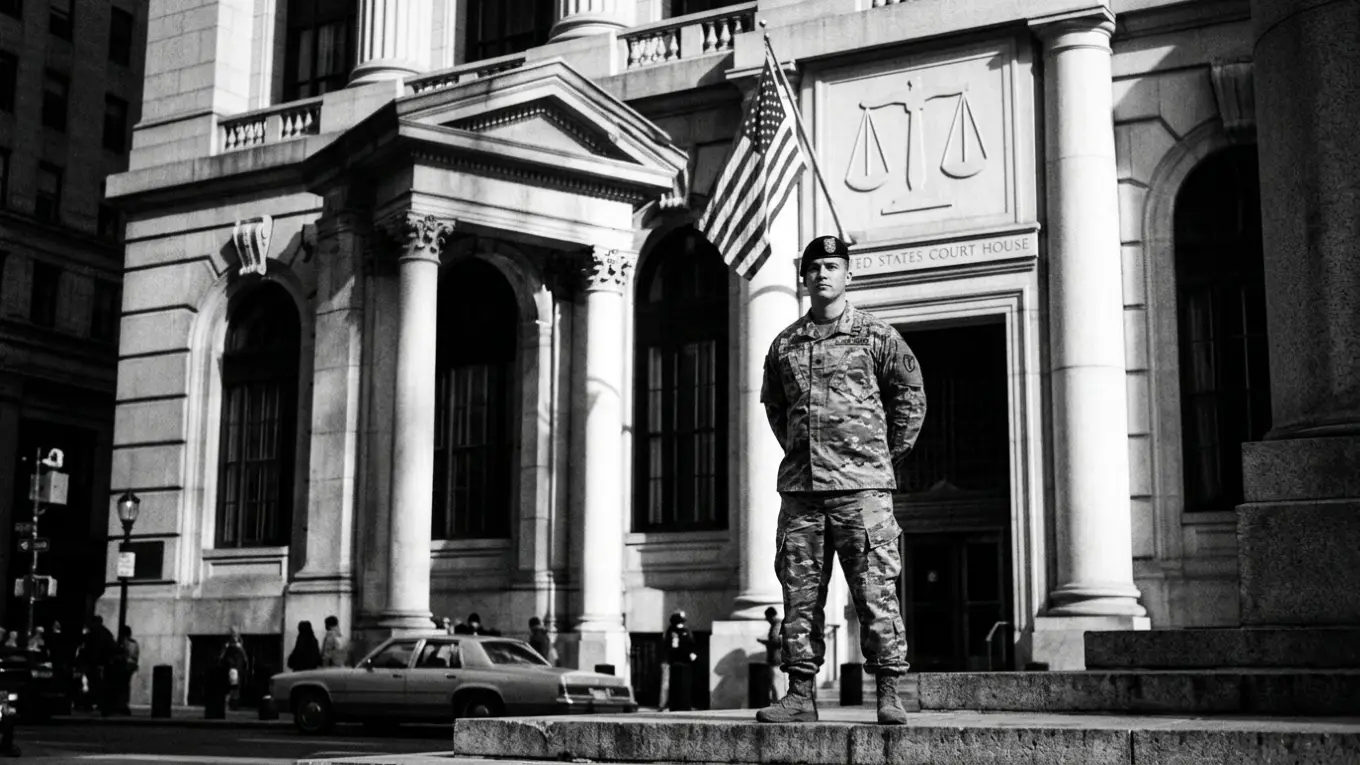
Newsom v. Trump Lawsuit Timeline and Updates
June 6, 2025 — ICE Raids and the Protests That Triggered Everything
Immigration and Customs Enforcement conducted workplace raids across Los Angeles on June 6, 2025. Protests began that evening and remained largely peaceful. Local authorities declared an unlawful assembly only for a nighttime disturbance near the federal Metropolitan Detention Center in downtown Los Angeles.
That same night, Trump acted. Defense Secretary Hegseth signed an order federalizing one in three of California’s active National Guard members under Title 10, Section 12406 of the U.S. Code. Governor Newsom learned of the order not from the White House, but from his own Adjutant General, who received it from the commander of U.S. Northern Command and immediately relinquished state command of the troops.
June 9, 2025 — California Files Suit
California filed Newsom v. Trump in the Northern District of California less than 48 hours after the federalization order. The complaint named Trump, Hegseth, and the Department of Defense as defendants. California’s legal team challenged the federalization from three angles: Trump exceeded his statutory authority under § 12406, the deployment violated the Posse Comitatus Act by using military forces for civilian law enforcement, and the action trampled state sovereignty under the Tenth Amendment.
The state also argued the action violated the Administrative Procedure Act because it was arbitrary, capricious, and contrary to law. A coalition of 18 attorneys general issued a statement condemning the federalization the same day the suit was filed. By June 12, a 21-state amicus brief supported California’s emergency motion.
June 12, 2025 — Judge Breyer Issues Emergency TRO
Judge Charles R. Breyer, a Clinton appointee in the Northern District of California, held a hearing and granted a temporary restraining order the same day. His ruling was direct: “At this early stage of the proceedings, the Court must determine whether the President followed the congressionally mandated procedure for his actions. He did not. His actions were illegal, both exceeding the scope of his statutory authority and violating the Tenth Amendment to the United States Constitution.”
The order required Trump to return control of the Guard to Governor Newsom. The Trump administration immediately sought an emergency stay from the Ninth Circuit.
June 17–19, 2025 — Ninth Circuit Sides With Trump, for Now
A three-judge Ninth Circuit panel — consisting of Circuit Judges Mark J. Bennett and Eric D. Miller, both Trump appointees, and Judge Jennifer Sung, a Biden appointee — heard arguments on June 17. The administration’s attorney, Brett A. Shumate, argued the president’s federalization decisions were “unreviewable” by courts entirely.
The panel rejected that sweeping claim. It was unwilling to say courts had no role at all. But it did conclude that Trump had likely acted lawfully under § 12406, granting an extended stay on June 19 that allowed the federalization to continue while the case proceeded. Governor Newsom expressed disappointment but welcomed the rejection of Trump’s absolute unreviewability argument.
August 5, 2025 — Trump Issues a New Federalization Order
With the initial 60-day federalization period set to expire, Trump issued a new 90-day extension order in early August, keeping 300 California National Guard troops under federal command. California challenged this extension as a separate unlawful act. The extension became the subject of the bench trial that followed.
September 2, 2025 — Judge Breyer Rules Trump Violated the Posse Comitatus Act
After a three-day bench trial, Breyer issued his most significant ruling. He found that the Trump administration violated the Posse Comitatus Act, 18 U.S.C. § 1385, by using federalized National Guard troops for civilian law enforcement activities. Evidence at trial showed that Guard troops had regularly accompanied federal agents on immigration enforcement operations from the first weeks of deployment, even when the military’s own risk assessments showed no threat requiring military support.
Breyer wrote: “It is profoundly un-American to suggest that people peacefully exercising their fundamental right to protest constitute a risk justifying the federalization of military forces. Such logic, if accepted, would dangerously water down this precondition for federalization and run headfirst into the First Amendment.” He issued a preliminary injunction barring military troops from civilian law enforcement in California.
September 3–4, 2025 — Trump Appeals; Ninth Circuit Stays the Injunction
The Trump administration filed an appeal on September 3. The following day, the Ninth Circuit granted an administrative stay of Breyer’s injunction, allowing the federalization to continue while the appeal was briefed and argued. The stay did not reflect any view on the merits — it was a procedural pause to preserve the status quo during appellate review.
October 5, 2025 — California Blocks Troop Deployment to Oregon
The Trump administration, after a federal district court in Oregon blocked the federalization of Oregon’s own National Guard, attempted to send 300 federally controlled California Guard members to Portland as a substitute. A federal judge granted a temporary restraining order the same day, blocking any federalization, relocation, or deployment of guard members from any state into Oregon. California joined Oregon’s suit. The court called the attempt an improper effort to “circumvent” her prior ruling.
October 22, 2025 — Ninth Circuit Denies En Banc Rehearing
The full Ninth Circuit declined to reconsider the panel’s earlier ruling permitting the federalization. A majority of eligible judges did not support rehearing en banc. The federalization remained in place. The Trump administration continued to assert that its federalization decisions were unreviewable, a position no court fully accepted.
December 10, 2025 — Breyer Orders the Deployment to End
In a second major ruling, Judge Breyer granted a preliminary injunction ordering the Trump administration to end the National Guard deployment in and around Los Angeles. He found that neither the August nor October extension orders met § 12406’s requirements, as conditions in Los Angeles had been calm for months and local law enforcement was fully capable of managing any civil unrest. His ruling included the now-widely quoted line: “The Founders designed our government to be a system of checks and balances. Defendants, however, make clear that the only check they want is a blank one.”
Breyer stayed his own order until December 15 to allow an appeal.
December 12, 2025 — Ninth Circuit Upholds Breyer’s Order
The Ninth Circuit upheld Breyer’s December 10 order two days later. It directed that federalized National Guard troops must leave Los Angeles by noon on December 15, 2025. The court kept the technical federalization in place pending further appeal, meaning the troops left the city but remained formally under federal command.
December 23, 2025 — Supreme Court Rules 6-3 Against Trump in Illinois
In a parallel case, Trump v. Illinois, the U.S. Supreme Court ruled 6-3 on December 23 that the Trump administration likely lacked authority under 10 U.S.C. § 12406(3) to federalize National Guard forces for domestic law enforcement. Chief Justice John Roberts, Justices Amy Coney Barrett and Brett Kavanaugh joined the three liberal justices in rejecting Trump’s position. The ruling, a shadow docket order, left in place a lower court block on Guard deployments to Chicago.
The Supreme Court’s reasoning was decisive: “regular forces” in the statute refers to the regular military, not the National Guard. Trump had deployed the Guard without first attempting to use the regular military to execute federal law, as the statute requires.
December 31, 2025 — Trump Abandons the Appeal; California Wins
Following the Supreme Court’s Illinois ruling, the Trump administration withdrew its motion to stay the district court’s order in the California case. The withdrawal allowed Breyer’s preliminary injunction to go fully into effect, returning command of the California National Guard to Governor Newsom for the first time since June 7. Attorney General Rob Bonta described it as Trump backing down in the face of a “stinging rebuke” from the nation’s highest court. Governor Newsom directed California National Guard leadership to work expeditiously to return service members home to their families.
January–February 2026 — Procedural Motions Continue
The case docket remained technically open into 2026. On January 14, the Ninth Circuit ordered supplemental briefing on whether the appeal was moot in light of Trump v. Illinois. The Trump administration filed a motion to dismiss on January 23. California responded on January 28. The parties filed a joint stipulation to stay district court briefing pending further guidance from the Ninth Circuit, citing the Supreme Court’s Illinois decision as potentially dispositive.
What the Lawsuit Alleged — The Three Legal Theories Explained
California’s complaint attacked the federalization from three distinct legal angles. Each one independently could have ended the deployment. Together, they gave the courts multiple paths to rule against Trump.
The statutory violation: 10 U.S.C. § 12406 permits federalization only under three narrow conditions: national invasion, rebellion or danger of rebellion, or the president’s inability to execute federal laws with regular forces. Trump relied on the third prong, arguing violent protesters prevented federal agents from operating. Courts found none of the three conditions met. The ICE protests were largely peaceful. Local law enforcement was functioning. Regular military forces had not been tried first.
The Posse Comitatus violation: The Posse Comitatus Act of 1878, codified at 18 U.S.C. § 1385, prohibits using military forces for civilian law enforcement. Once the California Guard was federalized under Title 10, the Act applied. Trial evidence showed Guard troops accompanied federal agents on immigration operations, conducted crowd control, and engaged in security patrols — classic civilian law enforcement functions. That was the violation.
The Tenth Amendment violation: States retain sovereign authority over their own militias under the constitutional framework. Seizing 4,000 state troops without consent — one in three of California’s available Guard members — stripped the state of real public safety capacity. California relied on the Guard for wildfire response, cybersecurity operations, drug interdiction, and disaster relief. The unlawful federalization diverted troops from those missions.
The Posse Comitatus Act — Why It Exists and What It Prohibits
The Posse Comitatus Act was passed in 1878 specifically to prevent the federal government from using the military to police civilian populations. Its name comes from the Latin phrase for “power of the county.” It was enacted after the Civil War and Reconstruction, when Union Army troops had been stationed throughout the South to enforce federal policy — a practice that many in Congress viewed as deeply incompatible with American democratic norms.
- Statute: 18 U.S.C. § 1385
- Enacted: 1878, post-Reconstruction Congress
- Core prohibition: Military forces cannot perform domestic civilian law enforcement functions
- Applies to National Guard: Yes, once federalized under Title 10 U.S.C.
- Criminal statute: Yes — violations can carry fines and imprisonment
- Exceptions: Narrow — insurrection, rebellion, direct presidential authorization under other statutes
In this case, the Posse Comitatus question became the heart of the bench trial. The government argued the Guard was protecting federal property and personnel, not conducting law enforcement. Breyer rejected that framing. Evidence showed a Trump administration official estimated that federalized Guard troops accompanied federal agents on immigration operations during the first weeks of deployment. Federal law enforcement officials routinely requested and received Guard assistance as a safety measure, even when the military’s own risk assessments showed no threat requiring their involvement.
The distinction matters legally: protecting a federal building is different from accompanying ICE agents on neighborhood raids. Breyer found the Guard was doing the latter. That was the Posse Comitatus violation.
10 U.S.C. § 12406 — The Statute Trump Misused
Section 12406 of Title 10 is a narrow statute. It was never designed as a general presidential power to deploy troops whenever unrest occurs. Congress wrote it with three specific conditions, all of which require actual, serious threats to national order.
| § 12406 Condition | What It Requires | Met in California? |
|---|---|---|
| Invasion or threat of invasion | A foreign power attacking or threatening U.S. territory | No |
| Rebellion or danger of rebellion | Armed insurrection against U.S. governmental authority | No — courts rejected this |
| Inability to execute federal laws | Regular military forces insufficient; laws cannot be enforced | No — local law enforcement was adequate |
Trump’s legal team also argued that under Martin v. Mott, an 1827 Supreme Court decision, courts cannot review the president’s determination that federalization conditions are met. Both Judge Breyer and the Ninth Circuit disagreed with that absolute position. Courts remained willing to examine whether the statutory conditions were actually satisfied — and found they were not.
The Supreme Court’s ruling in Trump v. Illinois resolved a related ambiguity. The Court held that “regular forces” in § 12406(3) refers to the regular U.S. military, not the National Guard itself. That means a president invoking the “unable to execute laws” prong must first try using the regular military before calling on the Guard. Trump went straight to the Guard without that step. The Court’s 6-3 majority found this likely made his actions unlawful.
What Trump Knew About Conditions in Los Angeles — and Deployed Anyway
One of the most damaging findings at the September bench trial was that the military’s own risk assessments did not support the deployment. Federal law enforcement officials requested Guard assistance as a routine “safety measure,” not because an actual threat existed requiring military support.
Breyer’s ruling drew a direct line between the protests — citizens demonstrating against immigration enforcement — and constitutionally protected First Amendment activity. He wrote that treating peaceful protest as a basis for military federalization would “dangerously water down” the preconditions the statute requires.
Court filings also revealed that by the time Trump issued his August extension order, conditions in Los Angeles had long returned to normal. Local law enforcement was handling any remaining public safety needs without difficulty. The administration nonetheless sought to keep Guard troops federalized for another 90 days. The court found this was not a genuine security determination. It was a political one.
The NIH grants termination lawsuit, where a federal judge similarly ruled that the administration had acted without legal justification in canceling over 2,000 research grants, reflects a pattern the California case reinforced: courts were increasingly willing to scrutinize Trump administration decisions that claimed unreviewable executive discretion.
How the Ninth Circuit’s Rulings Shifted Over Six Months
The Ninth Circuit’s handling of this case evolved significantly from June to December 2025. Early on, the three-judge panel found it likely that Trump had acted within his statutory authority, granting stays that kept the federalization alive. By December, the same circuit upheld Breyer’s order ending the deployment.
The shift reflects how much the factual record mattered. Early rulings involved emergency motions with limited evidence. By December, the court had a full bench trial record, including the Posse Comitatus findings, the evidence of Guard troops accompanying ICE agents, and months of post-deployment data showing Los Angeles had returned to normal. The facts caught up with the administration’s legal claims.
The Supreme Court’s Illinois Ruling and Its Impact on California
On December 23, 2025, in Trump v. Illinois, the Supreme Court ruled 6-3 against the Trump administration’s attempt to deploy National Guard forces to Chicago. The majority — Chief Justice Roberts, Justices Barrett and Kavanaugh joining the three liberal justices — held that the president likely lacked authority under § 12406(3) because “regular forces” in the statute refers to the regular military, and Trump had not attempted to use regular military forces before invoking the National Guard.
The ruling was technically a shadow docket order denying Trump’s motion for a stay, not a final merits decision. But the Supreme Court grants stays only when the applicant is likely to succeed on the merits. A denial signals the Court believes the opposite — that the administration’s legal position is likely wrong.
The California legal team cited Trump v. Illinois in supplemental briefings to the Ninth Circuit immediately. Eight days later, Trump dropped the California appeal entirely. The connection was direct: the Supreme Court’s reasoning in the Illinois case applied squarely to the California federalization. Continuing to fight was untenable.
The Mark Kelly Pentagon lawsuit — in which a sitting U.S. senator sued the Department of Defense for silencing his First Amendment rights — raised parallel questions about the Trump administration’s willingness to use military and executive authority to suppress constitutionally protected expression. Courts rejected that posture there as well.
California vs. Illinois, Oregon, and Washington D.C. — The Parallel Battles
California was the opening act in a broader legal conflict over presidential authority to federalize state National Guard units. Three other jurisdictions faced similar deployments and filed their own lawsuits.
| State | Lawsuit Filed | Key Development | Outcome |
|---|---|---|---|
| California | June 9, 2025 | Bench trial; Posse Comitatus violation found | Full win; troops returned Dec. 31, 2025 |
| Oregon | October 2025 | Initial block on Guard deployment; Trump tried to send California troops as substitute | TRO granted blocking all Guard deployments to Oregon |
| Illinois | October 2025 | SCOTUS ruled 6-3 against Trump; Guard blocked from Chicago | Major Supreme Court win for Illinois |
| Washington D.C. | August 2025 | 2,200+ Guard deployed; D.C. AG sought removal order | Ongoing litigation |
California’s case mattered beyond its own borders because it was first. Every subsequent state challenging Guard federalization cited Breyer’s June 12 TRO, his September Posse Comitatus ruling, and the Ninth Circuit’s eventual endorsement of those rulings. The legal architecture California built was the scaffolding the other states climbed.
What the Ruling Means for Presidential Military Power Going Forward
Before Newsom v. Trump, the outer limits of a president’s authority under 10 U.S.C. § 12406 had never been tested in litigation. No president had previously invoked that statute to federalize a state’s Guard over a governor’s explicit objection. The last time a president deployed the National Guard without a governor’s request was 1965, when President Lyndon B. Johnson sent the Guard to Alabama to protect a voting rights march. That was a different era, and a different legal context.
What the California case established, and what the Supreme Court’s Illinois ruling reinforced, are several durable legal principles. First, courts will review presidential federalization decisions — the claim of unreviewable executive discretion failed at every level. Second, the Posse Comitatus Act applies to federalized National Guard troops and limits what they can do on American streets. Third, § 12406(3) requires the president to have first attempted to use regular military forces before calling on the Guard. Fourth, peaceful protest cannot, by itself, constitute grounds for military federalization.
These rulings collectively narrow what future administrations can do. Any president seeking to federalize a state’s Guard for domestic purposes now faces a body of judicial precedent that will be cited against them.
Similar fights over federal power and state authority appear elsewhere on the docket. The DOJ grant cancellations lawsuit — in which a judge ruled that the administration had acted illegally in stripping $820 million in public safety funding from states — and the AmeriCorps funding lawsuit, where states won back $584 million in illegally cut federal program funds, reflect the same pattern of state-federal confrontation over executive overreach that defined the National Guard litigation.
What This Lawsuit Teaches Consumers and Citizens
The California National Guard federalization case is not a lawsuit most people would think to follow. There are no plaintiffs seeking compensation, no settlement checks, no eligibility forms. It is a constitutional lawsuit brought by a government on behalf of its people. But its lessons are broader than its legal parties.
The case demonstrated that the courts remain a functioning check on executive power, even when that power is asserted with confidence and urgency. At every level — district court, circuit court, Supreme Court — judges were willing to look behind the president’s claims, examine the actual facts on the ground, and rule against the administration when the law didn’t support its position.
It also revealed how the Posse Comitatus Act, a 147-year-old statute rarely discussed outside law school classrooms, still carries real force. The framers of that law understood that using military forces against civilian populations corrodes the relationship between government and the governed. The bench trial in this case produced evidence that is now on the public record: Guard troops accompanied ICE agents on immigration raids, in communities where no military threat existed, based on risk assessments that showed no justification for their presence.
The case also shows the value of rapid, coordinated legal response. California sued within 48 hours. Eighteen attorneys general issued statements within days. Twenty-one filed an amicus brief within a week. That speed mattered. It forced immediate judicial scrutiny before the deployment could become a settled fact on the ground.
For citizens in any state with a National Guard: the question of who controls those troops — and under what circumstances a president can take them away from a governor — is no longer theoretical. Courts have now answered it. The answer, for now, is that the president cannot do it simply because he decides he wants to.
Frequently Asked Questions
What is the California National Guard federalization lawsuit?
Formally known as Newsom v. Trump, it is a federal lawsuit filed June 9, 2025, by California and Governor Gavin Newsom against President Trump, Defense Secretary Hegseth, and the Department of Defense over the unlawful seizure of 4,000 state National Guard troops without the governor’s consent.
Did California win the National Guard lawsuit?
Yes. California won. Judge Charles Breyer found the deployment violated the Posse Comitatus Act after a bench trial. On December 31, 2025, Trump abandoned his appeal following a 6-3 Supreme Court ruling in a parallel Illinois case, and the Guard was returned to Governor Newsom’s command.
What law did Trump use to federalize California’s National Guard?
Trump invoked 10 U.S.C. § 12406, which allows a president to call state National Guard units into federal service under three narrow conditions: national invasion, rebellion, or inability to execute federal laws with regular forces. Courts found none of those conditions were met.
What is the Posse Comitatus Act and how did it apply here?
The Posse Comitatus Act (18 U.S.C. § 1385) is an 1878 federal law prohibiting the use of military forces for civilian law enforcement. Once federalized under Title 10, the California Guard became subject to it. Trial evidence showed Guard troops accompanied ICE agents on immigration operations, a clear violation.
What did the Supreme Court say about Guard federalization?
In Trump v. Illinois, the Supreme Court ruled 6-3 on December 23, 2025, that Trump likely lacked authority to federalize National Guard forces under § 12406(3) because he had not first attempted to use the regular military, as the statute requires. The ruling directly influenced Trump’s decision to drop the California appeal.
Who presided over the California National Guard case?
Judge Charles R. Breyer of the U.S. District Court for the Northern District of California, docket 3:25-cv-04870-CRB. The Ninth Circuit case was docketed as 25-3727. The three-judge Ninth Circuit panel consisted of Judges Mark J. Bennett, Eric D. Miller, and Jennifer Sung.
Can a president federalize a state’s National Guard without the governor’s consent?
Technically yes, under § 12406 — governors do not have veto power. But the president must satisfy one of three statutory conditions. Courts ruled Trump did not satisfy any of them in California. And once federalized, the Posse Comitatus Act limits how those troops can be used.
Was this the first time a president federalized a National Guard against a governor’s will?
Yes. On June 7, 2025, Trump became the first president in U.S. history to invoke 10 U.S.C. § 12406 to federalize a state’s National Guard over the explicit objections of that state’s governor. The last comparable action was in 1965, when President Johnson deployed troops to Alabama with that state’s consent.
Is the Newsom v. Trump case still ongoing in 2026?
The deployment ended December 31, 2025, and the troops were returned to state control. But the case docket remains technically open due to pending procedural motions. As of early 2026, the parties filed a stipulation to stay district court briefing while the Ninth Circuit considers whether the case is now moot.
What other states faced similar National Guard federalization lawsuits?
Illinois, Oregon, and Washington D.C. all faced Guard federalization and filed their own legal challenges. Illinois’s case produced the Supreme Court’s 6-3 ruling. Oregon won an initial block. The D.C. case involved over 2,200 Guard members deployed to the capital.
Did the California National Guard federalization affect state emergency services?
Yes. The federalization removed 4,000 troops — one in three of California’s available Guard members — from state missions including wildfire preparedness, cybersecurity operations, drug interdiction, and disaster response. California’s Adjutant General testified the loss of those troops created real public safety gaps.
What is the Martin v. Mott precedent and did it protect Trump?
Martin v. Mott (1827) suggested courts defer to presidential determinations about when militia federalization conditions are met. Trump’s legal team cited it as grounds for unreviewable executive discretion. Both Judge Breyer and the Ninth Circuit rejected that reading as an absolute bar to judicial review, and examined the facts regardless.

Leave a Reply