A subpoena is a court order. It commands someone to testify, hand over documents, or both. It is not a request. It is not optional.
The practical significance hits the moment one lands in your mailbox or your hand. You may not be a party to the lawsuit at all. You may have never heard of the case. None of that matters once you are served.
- What it is: A court-enforced order compelling testimony, documents, or both.
- Who it applies to: Witnesses, third parties, businesses, and sometimes parties to the case itself.
- When it matters: The moment you are properly served, a compliance clock starts running.
- Key exception: Privileged or protected information is not subject to compelled disclosure.
- Practical takeaway: Read it carefully, note the deadline, and talk to a lawyer before you ignore or comply.
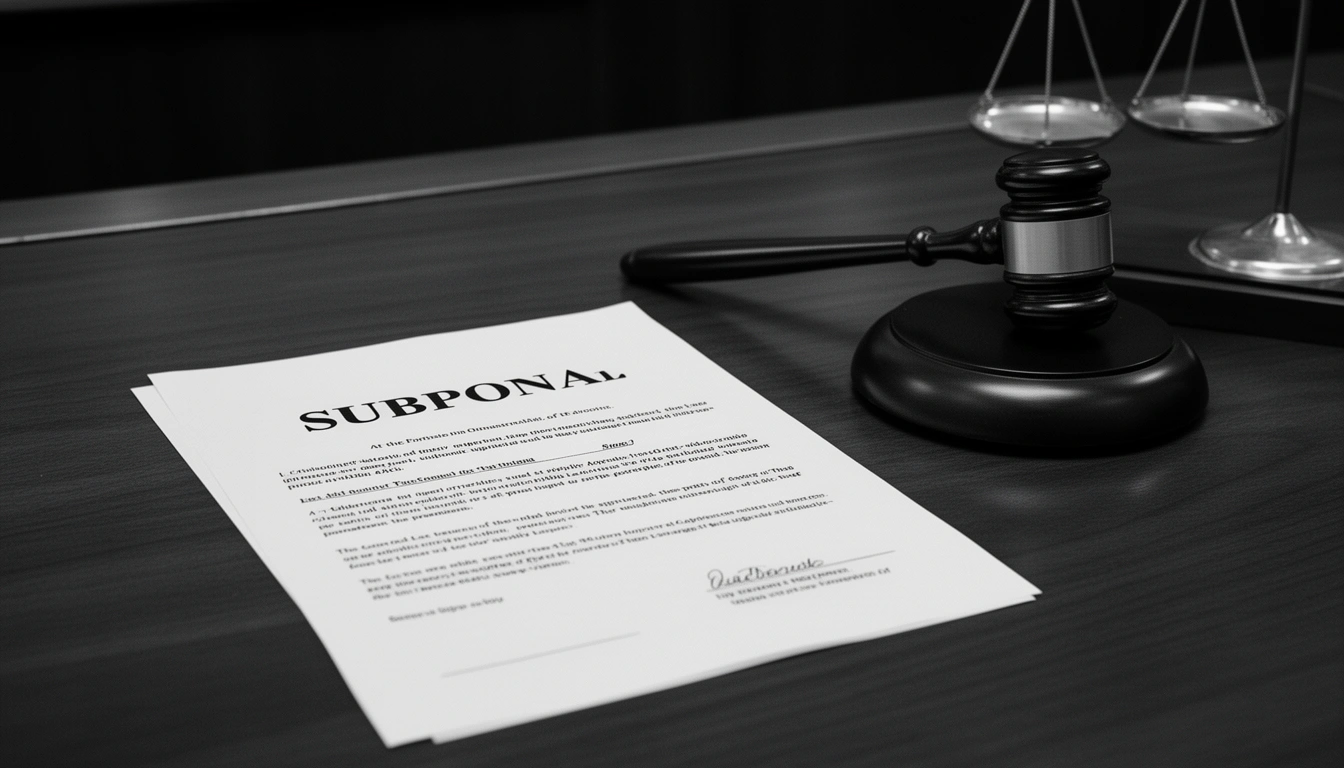
What Is a Subpoena?
A subpoena is a written, court-backed order that forces someone to testify, produce documents, or appear at a proceeding. The word comes from Latin, sub poena, meaning “under penalty.” That is not decoration. It is the entire point.
What matters here is the distinction between a subpoena and an ordinary request for help. A lawyer can ask you to talk. You can say no. A subpoena removes that option. Refuse, and the court can hold you in contempt.
The rules governing federal subpoenas live in two places. Civil lawsuits follow Rule 45 of the Federal Rules of Civil Procedure. Criminal cases follow Rule 17 of the Federal Rules of Criminal Procedure. Every state has its own parallel rule, and the details shift from state to state.
A summons notifies a defendant they are being sued and must respond. A subpoena commands a witness, party, or third party to testify or produce evidence. They serve different functions in the same lawsuit.
You do not need to be a defendant or plaintiff to receive one. Most subpoenas go to people who are not parties at all. A bank, a hospital, a former coworker, a social media company. Being sued and being subpoenaed are two separate legal events that happen to share a courtroom.
Why Subpoenas Exist
Courts cannot decide a case fairly without access to facts. Litigants on both sides need a way to reach evidence that sits outside their own control. The subpoena is that mechanism.
This is the core principle: a lawsuit is supposed to be decided on facts, not on whatever each side happens to already have in hand. The subpoena power exists to level that field.
Types of Subpoenas
There are two primary categories of subpoena: one compels testimony, the other compels documents, and a single subpoena can demand both at once.
| Type | Formal Name | What It Compels |
|---|---|---|
| Witness subpoena | Subpoena ad testificandum | Appearance and testimony at trial, hearing, or deposition |
| Document subpoena | Subpoena duces tecum | Production of records, files, or tangible evidence |
| Deposition subpoena | Deposition subpoena | Sworn testimony outside of court, during discovery |
| Grand jury subpoena | Grand jury subpoena | Testimony or documents in a criminal investigation, before charges are filed |
| Administrative subpoena | Administrative subpoena | Records or testimony, issued by a federal agency without prior judicial approval |
Subpoena Ad Testificandum
This is the classic witness subpoena. It orders a person to show up and testify under oath, at a trial, a hearing, or a deposition. No documents required. Just your presence and your sworn account.
Subpoena Duces Tecum
This one wants paper, not people. It demands documents, records, or physical evidence under your control. Bank statements, emails, internal memos, surveillance footage. If it exists and it is relevant, it can be subpoenaed.
The practical implication is this: producing documents under a duces tecum subpoena does not always require you to also appear in person. Read the document closely. It will say.
Deposition Subpoena
A deposition happens away from the courtroom, usually in a conference room, with a court reporter present. The testimony is sworn and recorded, but it happens during discovery, not during trial itself. A deposition subpoena compels a non-party to show up and answer questions in that setting.
Grand Jury Subpoena
Grand jury subpoenas live in a different world. No defendant has been charged yet. The grand jury is investigating, deciding whether enough evidence exists to bring an indictment. Federal grand juries operate under Rule 17 of the Federal Rules of Criminal Procedure, and the secrecy obligations around them are strict.
The pattern is familiar: federal courts give grand jury subpoenas heavy deference. The Supreme Court has held that a motion to quash on relevance grounds must be denied unless there is no reasonable possibility the materials sought will produce relevant information.
Administrative Subpoena
Here is where it gets complicated. Agencies like the IRS, the SEC, and the DEA can issue subpoenas of their own, without asking a judge first. Congress granted this power through specific statutes, agency by agency. Administrative subpoenas are not self-executing. If you refuse to comply, the agency cannot arrest you. It has to go to court and ask a judge to order compliance, and that step gives you a chance to push back before any penalty attaches.
Who Can Issue a Subpoena?
Subpoenas are issued under the authority of a court, but the physical act of signing one is usually performed by an attorney, a court clerk, or a grand jury, not a judge personally.
That surprises a lot of people. The presumption is that a judge has to sign off on every subpoena. In most civil litigation, that is not how it works.
- Attorneys of record, acting as officers of the court
- Court clerks, on request, in jurisdictions requiring clerk issuance
- Judges, directly, in some state courts or for unusual requests
- Grand juries, through the prosecutor presenting the case
- Federal and state administrative agencies, under specific statutory authority
Under the Federal Rules of Civil Procedure, the issuing court is the court where the underlying case is pending. An attorney representing a party in that case can issue the subpoena directly, using a form signed in the name of the clerk. No individual judicial review happens before it goes out the door.
Pro se litigants, people representing themselves without a lawyer, do not get this shortcut. They generally have to ask the court clerk to issue the subpoena for them.
Administrative Agencies Are a Different Animal
The Drug Enforcement Administration, the Internal Revenue Service, the Department of Homeland Security, and the Securities and Exchange Commission all hold administrative subpoena authority. No warrant. No judge. No grand jury. Just a statute that Congress passed, and an official within the agency authorized to sign.
This is the core principle: administrative subpoenas trade judicial oversight for speed. That tradeoff is exactly why they generate so much legal pushback, and why courts apply a reasonableness standard rather than the stricter probable cause standard used for search warrants.
Congressional Subpoenas
Congress can issue subpoenas too, through its committees, as part of its oversight and investigative function. The Supreme Court confirmed this power decades ago in McGrain v. Daugherty. Refusing a congressional subpoena can lead to a criminal contempt referral, a civil enforcement action, or, in rare cases, Congress’s own inherent contempt power.
How Are Subpoenas Served?
A subpoena must be delivered to the recipient in a manner the court accepts as valid, and the most common method remains personal, in-hand delivery by a process server.
Service is not a formality. An improperly served subpoena can be challenged and thrown out, regardless of what it asks for.
Personal Service
The subpoena gets handed directly to the named recipient. A process server, a sheriff’s deputy, or sometimes any adult who is not a party to the case can perform this. Personal service is the gold standard because it leaves no doubt the recipient received actual notice.
Substituted Service
Some states allow the subpoena to be left with a responsible adult at the recipient’s home or workplace, if personal delivery fails after reasonable attempts. The rules on what counts as “reasonable attempts” vary by state, and this is one of those areas where state law variations matter.
Service by Mail
A smaller set of jurisdictions permit service by certified mail for certain types of subpoenas, particularly document-only requests. This method carries more risk of challenge than personal service, since proving actual receipt is harder.
- Delivery to the correct named person or entity
- Delivery within the timeframe the court or rule requires
- A server who is not a party to the case
- Proof of service filed with the court, signed under penalty of perjury
- Witness fees included, where the subpoena commands a court appearance
Federal law requires the issuing party to pay an attendance fee, currently set at $40 per day, plus mileage, for anyone subpoenaed to appear. That payment requirement is baked into Rule 45 itself, not a courtesy.
Geographic Limits on Service
Rule 45 caps how far a person can be compelled to travel. In federal court, that limit generally sits at 100 miles from where the person lives, works, or regularly conducts business in person. Push past that line, and the subpoena becomes vulnerable to a motion to quash on geographic grounds alone.
What Happens If You Ignore a Subpoena?
Ignoring a properly served subpoena can result in a finding of contempt of court, which carries fines, a bench warrant, and in some cases jail time.
No warning was issued. No grace period applied. No second chance was automatic. That is what contempt of court means in practice once a judge decides the line was crossed.
A subpoena is a court order. Disobeying it is not like ignoring a phone call from opposing counsel. It is treated the same as disobeying a judge directly.
Civil Contempt
Civil contempt exists to force compliance, not to punish for its own sake. A judge can order fines that accumulate daily, or order the person jailed until they comply. Courts describe this as holding “the key to the cell” in your own pocket: comply, and the sanction ends.
Criminal Contempt
Criminal contempt punishes the act of disobedience itself, after the fact, and looks more like a criminal prosecution. It can result in a fixed fine, a fixed jail sentence, or both, depending on the jurisdiction and the severity of the refusal.
A bench warrant authorizes law enforcement to arrest a non-compliant person and bring them before the court. It is most often issued after a missed appearance, not after a paperwork dispute over documents.
Grand Jury Subpoenas Carry Sharper Teeth
Under Rule 17(g) of the Federal Rules of Criminal Procedure, failure to obey a grand jury subpoena without adequate excuse can be deemed contempt directly. There is no intermediate enforcement hearing required first. Administrative agency subpoenas work differently. The agency has to go to court and win an enforcement order before any sanction can attach, which gives the recipient a real chance to argue before the consequences arrive.
A Subpoena Does Not Mean You Are in Trouble
Receiving a subpoena is not an accusation. It usually means someone believes you have information relevant to their case, nothing more. The fear that comes with the envelope is rarely matched by the reality inside it.
Can You Challenge a Subpoena?
Yes, a subpoena can be challenged through a written objection, a motion to quash, or a motion for a protective order, depending on what the subpoena demands.
You cannot challenge a subpoena simply because complying is inconvenient. Courts require a recognized legal ground, and federal law draws a sharp line between grounds a court must accept and grounds a court may accept at its discretion.
Written Objection
If the subpoena seeks documents or inspection, Rule 45(d)(2)(B) lets the recipient serve a written objection directly on the party who issued it. The objection must go out before the earlier of the compliance deadline or 14 days after service. Once filed, the recipient does not have to produce anything until a court orders it. The burden shifts to the other side to file a motion to compel.
Motion to Quash: Mandatory Grounds
Under Rule 45(d)(3)(A), a court must quash or modify a subpoena in four situations. No discretion involved.
- The subpoena allows unreasonable time to comply
- The subpoena requires travel beyond the 100-mile limit
- The subpoena seeks privileged or otherwise protected material
- The subpoena subjects the recipient to undue burden
Courts generally treat seven days or less as unreasonable, and fourteen days or more as presumptively fine, though no fixed rule defines the line.
Motion to Quash: Discretionary Grounds
Rule 45(d)(3)(B) gives a court the option, not the obligation, to quash or modify a subpoena when compliance would expose a trade secret or confidential business information, or would force disclosure of an unretained expert’s opinion. A judge can let the subpoena stand anyway if the requesting party shows real need and agrees to fair compensation.
Motion for Protective Order
For discovery-related demands, Rule 26(c) offers a separate path: a motion for a protective order. This route requires the moving party to first confer with the requesting side before filing. Courts can use it to limit scope, restrict who sees the produced material, or shift the cost of compliance onto the party that issued the subpoena.
Where the Motion Gets Filed
Here is where it gets complicated. The motion to quash does not always go to the court hearing the underlying case. It goes to the court for the district where compliance is required, which can sit in a completely different state from where the lawsuit itself is pending.
What matters here is timing. Courts generally expect a motion to quash before the date set for compliance. Wait past that deadline, and the challenge becomes much harder to win, no matter how strong the underlying argument.
Common Misconception: You Cannot Just Refuse
Many people assume staying silent is itself a form of objection. It is not. Silence after service, with no written objection and no motion filed, leaves the subpoena standing. The deadline still runs. The contempt exposure still exists.
State Law Variations
Subpoena rules are not uniform across the country. Court motions generally follow similar logic state to state, but subpoena specifics diverge more sharply.
- Who is authorized to issue a subpoena without a judge’s direct signature
- The deadline to serve written objections, ranging from 14 to 21 days
- Whether substituted or mailed service is permitted
- The geographic radius compelling travel for non-party witnesses
- Whether civil contempt allows fines, jail, or both
Always check the specific rule in the state where the subpoena was issued, or where compliance is required. Federal rules offer a useful baseline, but they do not control state court proceedings.
Key Takeaways
- A subpoena is a court order, not a request, and ignoring one can lead to contempt, fines, or jail.
- The two core types compel testimony or documents, and a single subpoena can demand both.
- Most subpoenas are issued by attorneys as officers of the court, not by judges personally.
- Valid service requires proper delivery method, correct timing, and proof filed with the court.
- You can challenge a subpoena through a written objection, a motion to quash, or a motion for a protective order, but the window to act closes fast.
- Receiving a subpoena does not mean you are a suspect or a target. It usually means someone believes you have relevant information.
Frequently Asked Questions
Does receiving a subpoena mean I am being sued?
No. A subpoena means someone believes you have relevant testimony or documents. You can receive one without being a party to any lawsuit.
Can I ignore a subpoena if I think it is unfair?
No. Ignoring a subpoena without filing a written objection or motion to quash can result in contempt of court, fines, or a bench warrant.
How much time do I have to respond to a subpoena?
Under federal rules, written objections must be served before the compliance date or within 14 days of service, whichever comes first. State deadlines vary.
Can a subpoena force me to travel any distance?
No. Federal subpoenas generally cannot compel travel beyond 100 miles from where you live, work, or regularly do business in person.
What is the difference between a subpoena and a summons?
A summons notifies a defendant they are being sued. A subpoena commands a witness or third party to testify or produce evidence.
Can a private citizen issue a subpoena?
No. Subpoenas are issued under court authority, typically by an attorney acting as an officer of the court, a court clerk, or a judge.
What happens if a company refuses to comply with a subpoena?
The requesting party can file a motion to compel. If the court orders compliance and the company still refuses, it can face contempt sanctions, including fines.
Can I get paid for responding to a subpoena?
Yes. Federal law requires the issuing party to pay a $40 daily attendance fee plus mileage for anyone subpoenaed to appear.

Leave a Reply