Every day, people are injured on floors that should have been dry, on stairs that should have been repaired, and in parking lots that nobody bothered to maintain. A slip and fall lawsuit is the legal mechanism that holds property owners accountable for those failures. These claims fall under premises liability law, which requires anyone who owns, leases, or controls property to maintain a reasonably safe environment for those who enter it.
According to the National Safety Council, falls outside the workplace killed over 43,000 people in the United States in 2021 and sent hundreds of thousands more to emergency rooms. The legal system gives injured victims a direct path to compensation through premises liability litigation, filed in state civil courts across the country. There is no national MDL or class action structure for slip and fall cases. Each claim is individual, filed in the jurisdiction where the injury occurred.
- What: A civil lawsuit against a property owner who failed to address a known hazard, causing a visitor to slip, trip, or fall and suffer injury.
- Who: Injured plaintiffs vs. property owners, managers, landlords, businesses, or government entities.
- Status: Ongoing — millions of premises liability claims are filed annually across all 50 states.
- Injuries: Broken bones, spinal injuries, traumatic brain injuries, hip fractures, torn ligaments, chronic pain.
- Settlement: Minor injuries: $10,000–$50,000. Moderate: $50,000–$250,000. Severe: $250,000–$2 million+.
- Eligibility: Anyone injured on someone else’s property due to a hazard the owner knew or should have known about.
- Key date: Statute of limitations ranges from 1 to 6 years by state — most states allow 2 to 3 years from the date of injury.
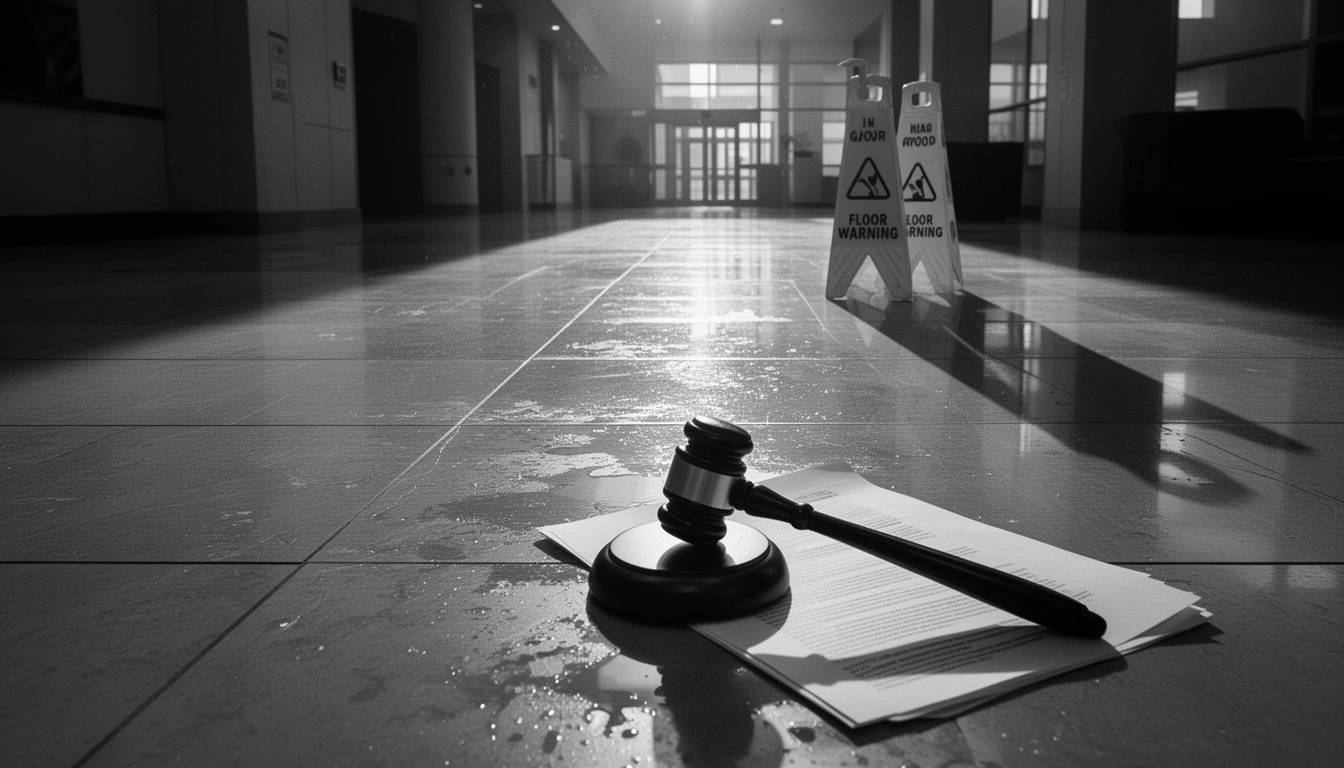
What a Slip and Fall Lawsuit Actually Alleges
A slip and fall lawsuit does not claim that someone simply fell. It claims that a property owner created or ignored a dangerous condition that caused the fall. The legal distinction matters. Property owners are not automatically responsible for every accident on their premises. They are responsible when they failed to act reasonably.
Premises liability law identifies four elements a plaintiff must prove to win. First, the property owner owed a duty of care to the plaintiff. Second, the owner breached that duty by failing to fix or warn about a hazard. Third, that breach directly caused the plaintiff’s injury. Fourth, the plaintiff suffered actual damages as a result.
The hazard types that commonly support these claims include: wet or freshly mopped floors without warning signs, broken or uneven flooring, spilled liquids left unaddressed for extended periods, ice and snow buildup on walkways, poor lighting in stairwells or corridors, missing handrails, and debris or objects left in pathways. Property owners must either correct these conditions promptly or warn visitors about them. Failure to do either is the foundation of most slip and fall claims.
The Notice Requirement: What Property Owners Actually Have to Know
Courts ask a precise question in slip and fall cases: did the property owner know, or should they reasonably have known, about the dangerous condition? This is the notice requirement, and it is where many cases are won or lost.
There are two types of notice. Actual notice means the owner was directly aware of the hazard — someone reported it, an employee created it, or an inspection documented it. Constructive notice means the hazard existed long enough that a reasonable owner exercising ordinary care should have discovered and addressed it.
Courts assess constructive notice by looking at how long the condition existed. A spill that sat for two hours in a grocery store aisle creates a stronger constructive notice argument than one that appeared moments before the fall. Previous complaints about the same condition, maintenance logs, incident reports, and surveillance footage are all evidence courts examine to establish what the owner knew and when they knew it.
This distinction matters enormously. Prior complaints about a specific hazard — unrepaired stairs, a persistently leaking pipe, a poorly lit parking lot — can transform a single-incident claim into a pattern-of-negligence case. That shift changes settlement leverage dramatically, similar to the pattern of corporate concealment documented in the Roundup cancer lawsuit, where what a defendant knew and when became central to the entire litigation.
Slip and Fall Lawsuit Timeline and Key Legal Stages
Incident and Immediate Documentation
The clock starts the moment someone falls. What happens in the first 24 to 48 hours shapes the entire case. Victims should photograph the hazard before it is cleaned up, report the incident to the property owner or manager in writing, seek medical attention immediately, and collect contact information from any witnesses. Surveillance footage is often overwritten within days. A preservation letter sent to the property owner by an attorney can prevent that evidence from disappearing.
Insurance Claim Filing
Most slip and fall cases begin as insurance claims, not lawsuits. Property owners and businesses carry premises liability insurance. A plaintiff’s attorney files a demand with the insurer, who then investigates the claim. Insurance adjusters review medical records, incident reports, surveillance footage, and witness statements. They assess both liability and damages before making an offer.
Insurance companies are profit-driven. Their initial offers routinely undervalue claims by excluding non-economic damages like pain and suffering, mental anguish, and loss of enjoyment of life. Accepting the first offer without legal representation is one of the most common and costly mistakes victims make.
Filing a Lawsuit in Civil Court
If insurance negotiations fail or produce an inadequate offer, the plaintiff’s attorney files a formal complaint in the appropriate state court. The venue is typically the county where the injury occurred. Cases involving damages under $25,000 may be filed in limited-jurisdiction courts. Higher-value claims proceed to general civil courts. In states like New York, claims may be filed in the Civil Court of the City of New York for damages up to $50,000, or in Supreme Court for unlimited damages.
Discovery
Discovery is the formal exchange of evidence between parties. The plaintiff’s attorney requests maintenance logs, inspection records, prior incident reports, employee training records, and internal communications. Depositions are taken from property managers, maintenance staff, and witnesses. Safety experts may be retained to analyze whether the property met applicable codes and standards. This phase typically takes six to twelve months.
Mediation and Settlement Negotiations
The vast majority of slip and fall cases settle before trial. The American legal system resolves approximately 96% of all personal injury claims through settlement. Mediation sessions, where a neutral third party facilitates negotiation between plaintiff and defense counsel, often produce final agreements. Settlement amounts depend on the strength of negligence evidence, injury severity, insurance policy limits, and the plaintiff’s willingness to proceed to trial.
Trial
When settlement fails, the case goes to a jury. Trial outcomes in slip and fall cases vary widely. A 2024 report by Marathon Strategies found that verdicts exceeding $10 million in premises liability cases rose 52% compared to the prior year. Juries exposed to clear evidence of corporate negligence and ignored prior complaints often award substantial damages. The 4% of cases that reach trial tend to involve either disputed liability or defendants who refused to offer fair compensation.
What the Largest Verdicts Reveal About Jury Thinking
The highest slip and fall verdicts in American legal history reflect one consistent pattern: property owners who knew about a hazard, documented it internally, and still did nothing. Juries punish that combination severely.
In a 2004 Pennsylvania case, a University of Pennsylvania medical student fell into an uncovered manhole and suffered a broken back and spinal injuries. The jury initially awarded $85 million before the parties agreed to cap the settlement at $18 million. In a separate New York case, a construction worker fell from defective scaffolding, injuring his back, neck, ribs, leg, and foot. The jury awarded $18 million, with an additional $3 million for his wife for loss of consortium.
In Las Vegas, a woman shopping at a Lowe’s Home Center slipped on a wet substance in the gardening department and suffered a skull fracture, brain hemorrhage, chronic headaches, and anxiety. The jury awarded $13 million. At a Virginia convenience store, a woman fell and hit her head, developing a brain injury and ongoing seizures. She recovered $12.2 million.
A California jury recently awarded $50 million to a delivery driver scalded by hot liquid at a drive-through, assigning full liability to the company for the unsafe condition. These outcomes signal something important to defendants: when negligence is egregious and injury is life-altering, juries do not cap their sympathy at insurance policy limits.
How Settlement Amounts Are Calculated
Slip and fall settlements are not arbitrary. They follow a structured calculation of economic and non-economic damages. The final number reflects how severe the injury is, how strong the negligence evidence is, and how much the defendant’s insurer wants to avoid a jury.
Economic damages are calculable. They include past and future medical expenses, lost wages during recovery, reduced future earning capacity, and rehabilitation costs. Non-economic damages are harder to quantify but often represent the largest component of a settlement. Courts and insurers use multipliers — typically 1.5 to 5 times economic damages — to calculate pain and suffering, emotional distress, and loss of enjoyment of life. The more severe and permanent the injury, the higher the multiplier applied.
One factor drives settlements up more than any other: surgery. Cases involving surgical intervention settle at roughly three times the rate of non-surgical cases with equivalent injuries. Knee replacement settlements average $300,000 to $600,000. Spinal fusion cases routinely exceed $750,000. A fall on ice that results in multiple herniated discs requiring surgery can produce a settlement in the $400,000 to $800,000 range.
| Injury Severity | Estimated Settlement Range | Typical Qualifying Factors |
|---|---|---|
| Minor (bruises, sprains, minor cuts) | $10,000 – $50,000 | Clear negligence, full recovery within weeks |
| Moderate (fractures, torn ligaments, surgery) | $50,000 – $250,000 | Medical treatment documented, months of recovery |
| Severe (spinal injury, TBI, permanent disability) | $250,000 – $2 million+ | Permanent impairment, ongoing medical needs, lost career |
| Catastrophic (paralysis, severe TBI, wrongful death) | $1 million – $85 million | Life-altering injury, gross negligence by defendant |
Where You Fall Matters: How Location Affects Your Claim
Slip and fall cases are governed by state law. The state where the accident occurred determines the statute of limitations, the comparative negligence rules, and available damages. These variations are not minor. They can mean the difference between a valid claim and a dismissed one.
Most states apply a two to three year statute of limitations for personal injury claims. Florida sets a two-year window under Florida Statutes section 95.11. Texas also requires filing within two years under Texas Civil Practice and Remedies Code section 16.003. New York allows three years under CPLR section 214. California gives two years. Connecticut gives two years. States like Maine allow up to six years.
Government-owned property creates shorter deadlines. In New York, victims injured on city or municipal property must file a Notice of Claim within 90 days of the injury. Failure to meet that deadline bars the lawsuit entirely. Florida applies its Tort Claims Act to government fall cases, adding procedural complexity that demands an attorney’s involvement from day one.
Comparative negligence rules vary as well. Most states follow a modified comparative negligence standard: if the plaintiff is found more than 50% at fault for the accident, they cannot recover damages at all. New York follows the pure comparative negligence model, which allows recovery even if the plaintiff bears 99% of the fault — though the award is reduced by that percentage. A handful of states, including Virginia, Maryland, Alabama, and North Carolina, still follow contributory negligence rules, which bar any recovery if the plaintiff bears even 1% of the fault. Victims in those states face a far higher burden.
Who Can Be Sued and Who Bears Liability
The common assumption is that property owners are always the defendants in slip and fall cases. The reality is more complex. Liability can attach to any party who owned, leased, managed, occupied, or controlled the property where the injury occurred.
A grocery store chain can be liable. So can the private maintenance contractor the store hired to mop floors. A landlord can be liable for a defective staircase in a residential building. So can the property management company that handled repairs. A government agency can be liable for a crumbling public sidewalk. Identifying all potentially liable parties is one of the first tasks an attorney handles, because additional defendants mean additional insurance coverage and a stronger negotiating position.
The legal status of the visitor also affects the duty of care owed. Invitees, such as customers in a store or guests at a hotel, receive the highest duty of care. Property owners must actively inspect for and correct hazards. Licensees, such as social guests, receive a duty to warn about known hazards. Trespassers receive the most limited protection, though even some duties apply, particularly when the trespasser is a child.
What the Rise in Premises Liability Claims Tells Us
Premises liability litigation is increasing sharply. Federal tort cases rose 20% between 2022 and 2024, according to Risk and Insurance reporting. Premises liability claims specifically jumped from 4,516 cases in 2022 to 5,632 cases in 2024. The severity of general liability claims on commercial properties has risen 57% over the past decade, according to The Baldwin Group.
The verdicts are growing too. Premises liability verdicts exceeding $10 million rose 52% in 2024 compared to 2023. Insurance industry sources report that what once settled for $50,000 — a sprained ankle — is now settling for $1 million or more in some jurisdictions. Several factors drive this: more aggressive plaintiff-side legal marketing, better use of expert witnesses and safety engineers, improved documentation of injuries through medical imaging, and juries increasingly skeptical of corporate negligence.
The pattern is familiar to anyone tracking mass tort litigation. When individual cases start producing large verdicts, defendants settle faster and for more. That dynamic is now playing out in premises liability. Property owners and their insurers are being forced to reckon with the true cost of deferred maintenance and ignored hazard reports.
The Evidence That Determines Whether a Case Wins or Settles High
Not all slip and fall cases are equal. Evidence quality is the single largest determinant of settlement value. Cases built on solid documentation consistently outperform those without it.
The most valuable evidence categories are: photographs or video of the hazard taken immediately after the fall, incident reports filed with the property owner, witness statements identifying the hazard, surveillance footage from the scene, medical records documenting injuries and treatment, prior complaints or maintenance requests related to the same condition, and expert opinions from safety engineers or slip-resistance specialists.
Surgical cases with immediate MRI documentation settle for approximately 60% more than delayed diagnosis cases with equivalent injuries. Traumatic brain injury cases with cognitive testing documentation achieve 45% higher settlements on average. The pattern is consistent: documentation created close in time to the injury, by medical professionals and independent witnesses, produces the highest recoveries.
What hurts cases? Delayed medical treatment. Social media posts contradicting injury claims. Signing an early release or accepting a quick cash settlement before understanding the full scope of injuries. Failing to preserve the scene. Each of these gives defense attorneys leverage they will exploit aggressively.
- You were injured on property owned, leased, or controlled by another party
- A hazardous condition existed on the property at the time of the fall
- The property owner knew or should reasonably have known about the hazard
- The owner failed to fix the hazard or provide adequate warning
- You suffered physical injuries and documented damages as a direct result
- Your injury occurred within the applicable statute of limitations window
How Long the Process Takes and What Slows It Down
Simple slip and fall cases with clear liability and fully recovered injuries often resolve in six to twelve months. These are straightforward insurance negotiations that never require filing suit. The injury is documented, the negligence is obvious, and the insurer calculates that settlement is cheaper than litigation.
Cases involving disputed liability, severe injuries, or government defendants take substantially longer. Contested liability cases typically run twelve to twenty-four months. Cases that go to trial can take two to three years from filing to verdict. The National Safety Council notes that 17,000 senior adults are hospitalized annually in New York City alone from fall injuries — and their cases often extend further due to disputes over pre-existing conditions.
Three factors consistently slow cases down. First, insurance company delay tactics: requesting additional documentation repeatedly, stalling on responses, making lowball offers to exhaust the plaintiff. Second, pre-existing condition disputes: defendants argue that the plaintiff’s injuries were caused or worsened by conditions that existed before the fall. Third, comparative fault arguments: defendants claim the plaintiff was partly responsible, reducing the available damages.
An experienced premises liability attorney counters all three. They respond to documentation requests immediately, retain medical experts to separate pre-existing conditions from new injuries, and gather evidence that anticipates comparative fault arguments before defense counsel raises them. Plaintiffs who navigate this process without legal representation routinely leave significant money on the table.
Property Types and Why They Affect Outcome
Where a slip and fall occurs significantly affects how the case develops. Different property types carry different duty-of-care standards, different insurance coverage structures, and different jury sympathies.
Retail establishments, including grocery stores, big-box retailers, and shopping malls, generate the highest volume of slip and fall claims. These defendants carry substantial commercial liability insurance and have extensive internal documentation — maintenance schedules, spill logs, cleaning records, and incident reports — that plaintiffs’ attorneys can subpoena. Produce spills in grocery stores have produced multi-million dollar verdicts where store records showed employees were aware of recurring wet conditions near refrigerator units.
Medical facilities carry the highest average settlements due to the vulnerability of their clientele. Elderly and disabled patients at hospitals, nursing homes, and rehabilitation centers are particularly susceptible to catastrophic injury from falls. A broken hip in a 75-year-old can end independent living permanently.
Municipal sidewalks and public property introduce special procedural requirements. Government defendants are protected by sovereign immunity doctrines, which limit liability and impose tight notice deadlines. A victim who misses the 90-day Notice of Claim requirement in New York may lose the right to sue the city regardless of how strong the case is. Premises liability cases against government entities should never be navigated without an attorney familiar with local tort claims procedures.
Similar accountability failures have played out across industries. The Travis Scott Astroworld lawsuit raised comparable questions about venue management and negligent failure to respond to known dangerous conditions, ultimately resulting in thousands of plaintiffs pursuing damages against both the artist and the event promoters. The Camp Mystic lawsuit, where plaintiffs alleged that flood warnings were ignored and children left in dangerous conditions, also centered on what property managers knew and whether they acted on that knowledge. The State Farm homeowner lawsuit illustrates the insurance dimension: when insurers act in bad faith by denying or undervaluing legitimate claims, policyholders — including slip and fall defendants — face separate accountability for how they handle compensation obligations.
The Defense Playbook: What Property Owners Argue and How Plaintiffs Counter
Property owners and their insurance attorneys follow a predictable script when defending slip and fall claims. Understanding the defense strategy before litigation begins is how plaintiff attorneys build cases that are harder to attack.
The most common defenses are: the hazard was open and obvious, meaning the plaintiff should have seen and avoided it; the hazard existed for such a short time that the owner could not reasonably have known about it; the plaintiff was contributorily negligent and partly caused their own fall; and the plaintiff had a pre-existing condition that accounts for the injury claimed.
The open and obvious defense has been weakened in many states. Colorado eliminated it as a complete bar to recovery entirely, instead treating the hazard’s visibility as a factor in comparative negligence. Most courts now recognize that a visible hazard does not excuse an owner from maintaining safe premises — it simply affects the allocation of fault.
Pre-existing condition defenses require direct rebuttal from treating physicians who can establish that the fall caused new injuries distinct from prior conditions. This is a medical argument made through medical records, not a legal one made through attorney argument. Plaintiffs who seek prompt medical attention and treatment create the documentation record needed to rebut these claims directly.
What This Lawsuit Teaches Consumers
Slip and fall litigation teaches a lesson that extends well beyond any individual plaintiff’s case. Property owners — commercial and residential — operate within a legal system that assigns real financial consequences to deferred maintenance. When a store manager walks past a wet floor four times without placing a cone, that is not just carelessness. Under premises liability law, it is a decision with a price tag.
The sharp rise in premises liability claims over the past three years reflects growing plaintiff sophistication, not growing frivolousness. Victims now know that surveillance footage exists and must be preserved. They know that incident reports are discoverable. They know that prior complaints about the same hazard become powerful evidence. Law firms that once handled only major personal injury cases now aggressively pursue premises liability claims, because the litigation infrastructure finally supports them.
For consumers injured in a fall, the lesson is clear: document everything immediately, seek medical treatment without delay, and consult an attorney before engaging with an insurance adjuster. The insurer’s interests and the plaintiff’s interests are structurally opposed. The first offer almost never reflects what the case is worth. And the statute of limitations is an absolute cutoff — missing it means losing the right to sue, regardless of how serious the injury was or how negligent the property owner clearly was.
Property owners should take equal notice. Premises liability verdicts now routinely exceed what inadequate maintenance cost to fix. The math of negligence is no longer in their favor.
Frequently Asked Questions
What is a slip and fall lawsuit?
A slip and fall lawsuit is a premises liability claim against a property owner, manager, or business that failed to maintain safe conditions, causing a visitor to fall and suffer injury. Plaintiffs must prove the owner knew or should have known about the hazard and failed to fix or warn about it.
What is the current status of slip and fall lawsuits?
Slip and fall premises liability claims are actively filed daily across all 50 states. Federal premises liability case filings rose from 4,516 in 2022 to 5,632 in 2024, and verdicts exceeding $10 million increased 52% in 2024 compared to 2023.
Who qualifies to file a slip and fall claim?
Anyone injured on another party’s property due to a hazardous condition the owner knew or should have known about qualifies to file. The injury must be documented, and the claim must be filed within the statute of limitations — typically 2 to 3 years from the date of injury depending on the state.
How much can I receive in a slip and fall settlement?
Minor injuries with clear negligence typically settle for $10,000–$50,000. Moderate injuries requiring surgery settle for $50,000–$250,000. Severe or permanent injuries, including spinal damage or traumatic brain injury, can reach $250,000 to $2 million or more.
What injuries are covered in a slip and fall claim?
Covered injuries include broken bones, herniated discs, spinal injuries, traumatic brain injuries, hip fractures, torn ligaments, skull fractures, chronic pain, and permanent disability. Psychological injuries including anxiety and depression stemming from the accident are also compensable.
What proof or medical records do I need to file?
You need medical records documenting diagnosis and treatment, photographs of the hazard, the incident report filed with the property owner, witness contact information, and evidence of lost wages. Surgical records and MRI documentation significantly strengthen the claim.
How long do I have to file a slip and fall lawsuit?
Most states allow 2 to 3 years from the date of injury. Florida and Texas set a 2-year limit. New York and California set a 2-year limit, though New York CPLR section 214 provides 3 years for general negligence claims. For government-owned property, notice requirements can be as short as 90 days.
Can I still file if the property owner cleaned up the hazard?
Yes. The hazard’s removal does not eliminate liability. Witness statements, surveillance footage, prior incident reports, and your medical records establish what existed at the time of the fall. Courts evaluate the condition at the moment of injury, not afterward.
What is the statute of limitations and can I still file?
The statute of limitations sets the deadline to file a lawsuit. Most states allow 2–3 years from the injury date. Missing this deadline bars your claim permanently. Exceptions may apply for minors, victims who were mentally incapacitated, or cases where the injury was not immediately discoverable.
Do I need to appear in court or can everything be handled remotely?
Approximately 96% of slip and fall cases settle without a trial. If your case settles, you typically provide a deposition but never appear in court. If the case goes to trial, personal attendance is required. Most procedural steps are handled by your attorney.
How do contingency fee arrangements work in slip and fall cases?
Most personal injury attorneys handle slip and fall cases on contingency, meaning no upfront cost. The attorney collects a percentage of the final settlement or verdict — typically 33% pretrial and 40% if the case goes to trial. If you recover nothing, the attorney receives nothing.
Are slip and fall settlement payouts taxable?
Under IRS guidelines, compensatory damages for physical injuries — including medical expenses, lost wages, and pain and suffering — are generally not taxable. Punitive damages are taxable. Consult a tax professional for guidance specific to your settlement structure.
Can family members file on behalf of a deceased slip and fall victim?
Yes. If a victim dies from injuries sustained in a slip and fall, surviving family members can file a wrongful death claim. Eligible claimants typically include spouses, children, and parents, depending on state law. Damages include funeral costs, lost future income, and loss of companionship.
What happens if the property owner has no insurance or limited coverage?
If the at-fault party lacks insurance or their policy limits are insufficient, your attorney can identify other potentially liable parties — maintenance contractors, property management companies, or parent corporations — who may carry separate coverage. In rare cases, judgments can be enforced against personal assets.

Leave a Reply